I remember some Oprah episode where Dr. Phil said, “You’re fat. Don’t sugarcoat it, or you’ll eat that, too.”
That type of talk really plays into our inner critics. Our inner critics who worry about us and about others. Turns out that kind of talk is often demoralizing and doesn’t work. The first part of it, at least, the personal judgment/condemnation part.
The second part, however, is a powerfully important part of the change process. That is the honesty/acceptance/acknowledgement aspect of the change process. This acknowledgement piece is what enables us to say to ourselves, ‘we want something different.’
Medicine is very opinionated sometimes, and from the traditional medicine perspective it cares very much what your weight and weight for height ratio is. So much so, your BMI is documented and tracked at nearly every visit and attached in a variety of ways to high risk billing codes and risk factor scores. (By the way, Medicare Advantage companies make more money off you when you have an elevated BMI, and pharmaceutical companies make a killing on GLP1s and companies make a ton of profit selling you food that is killing you, but perhaps that is another blog post. I digress…)
For me, though, discussions about my own weight are non-starters. As a physician, when we collect BMI data in the office, I often watch my patient start talking about their weight, judging themselves and beating themselves up with words like ‘should,’ ‘need,’ and ‘ought to.’ The cumulative effects can be soul-crushing on the hapless victim (the patient) and the authority figure (doctor).
There has to be a better way.
That’s why at Candid we do things differently. We are a person-first practice. What matters here is You.
Let me put this in perspective. I have a pretty serious, exercise limiting back-injury. Then in January of this year, I suffered a serious knee injury. Exercise has been challenging. Plus I started working part-time night shifts and my weight has stagnated above a healthy level.
Blah, blah, blah. This type of talk isn’t accomplishing much. Let’s put it another way, my ability to participate in family hikes is in grave jeopardy.
So I recently visited the orthopedist. One treatment option is knee replacement surgery. (We’re not doing that). He didn’t mention weight loss. Did you know, losing 10-20% of your body weight has equivalent pain control as knee replacement surgery.
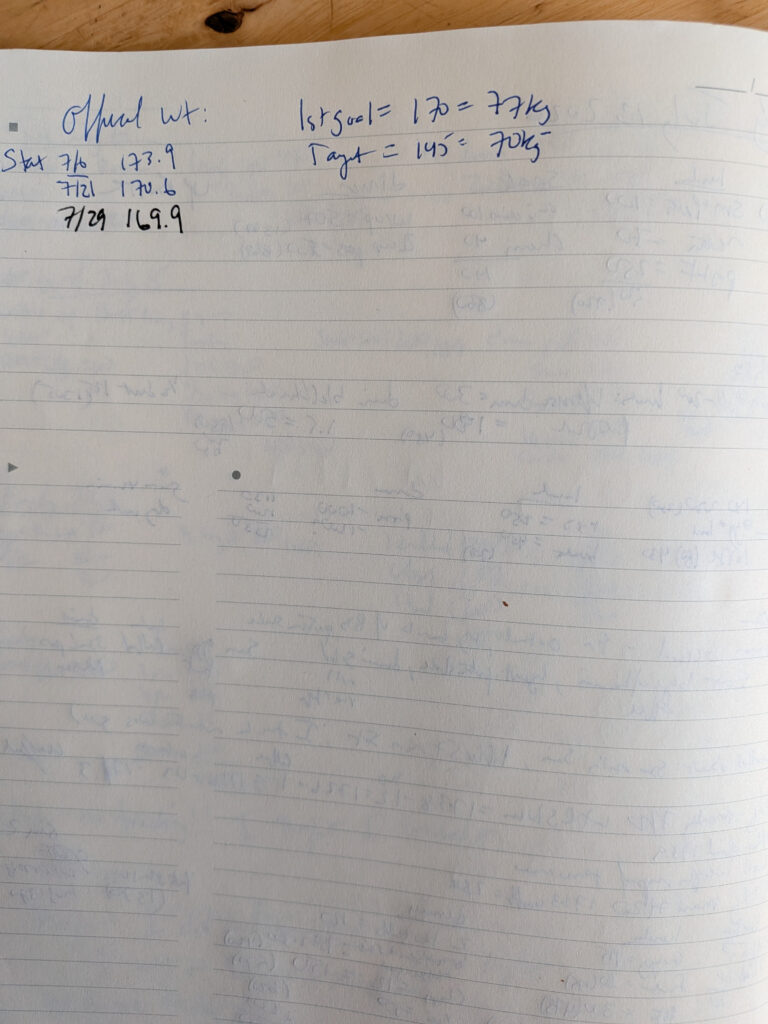
Translation, if I’m a more ideal weight for height ratio, I may regain my ability to hike in the backcountry! Say what? I started this journey at 173.9 lbs. 20% weight loss would make me weigh 139 pounds. I happen to think my body really works great when I weigh less than 145 pounds (a 17% wt loss).
Step 1, Acknowledgement. Step 2, Decide to Change/Plan. Step 3, Keep yourself accountable. So this notebook is my accountability journal. I am following the ACLM guidelines for weight loss.. the same guidelines that reverse diabetes, by the way. And this notebook is how I track how well I implement things and tweak what I’m doing.
Is it a notebook or a Backcountry hike in the making?
-Dr. Joe
Need a change partner? Sign up with me for a coaching or coaching + Lifestyle Medicine journey.
first published 9 Aug 2026